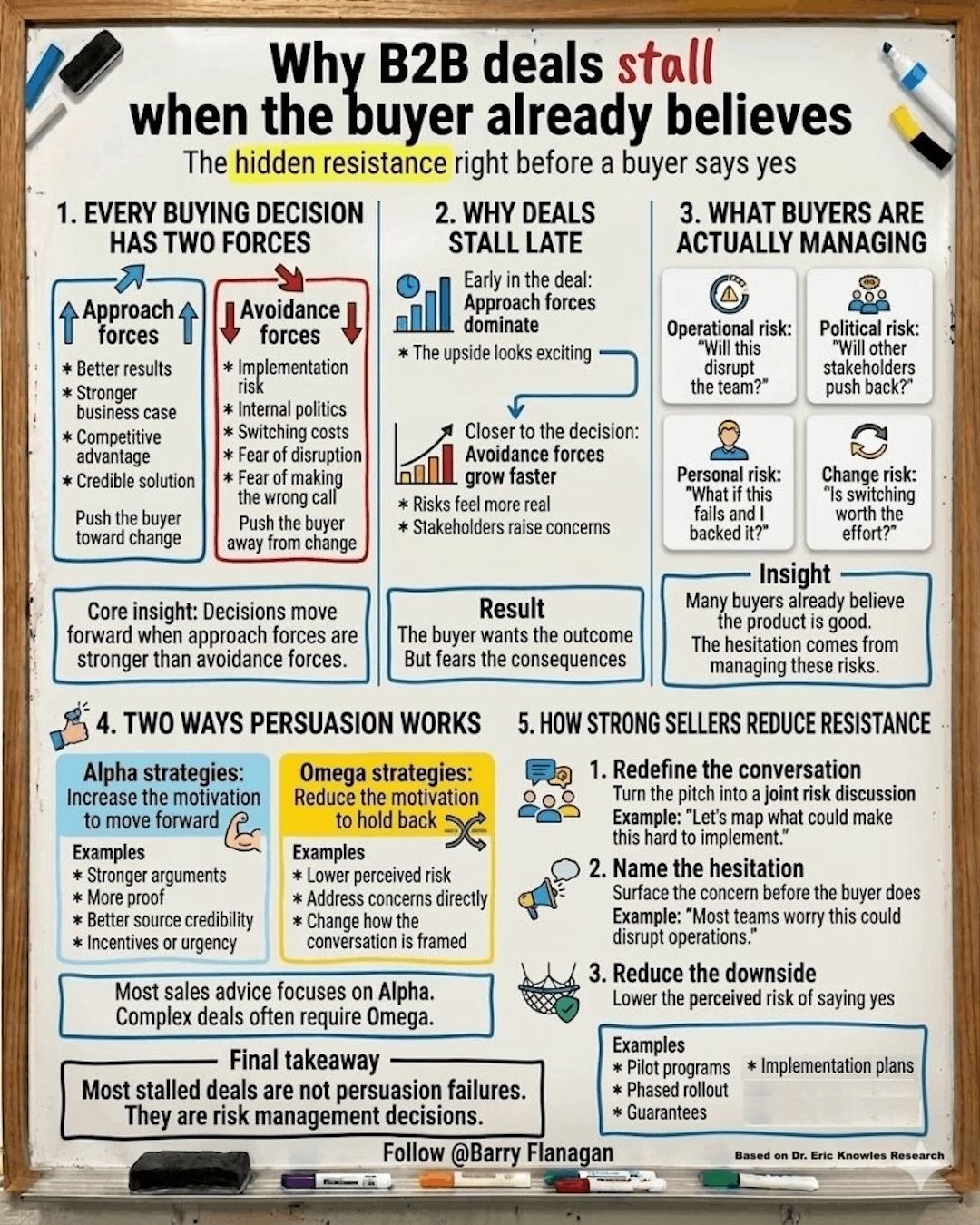
Deals rarely stall because the buyer isn’t convinced
Deals rarely stall because the buyer isn’t convinced. They stall because the buyer is anxious.
Robert Cialdini studied why people say yes. Eric Knowles studied why people say no.
Most B2B sales training lives on the Cialdini side.
Better arguments. More proof. More urgency. More reasons to buy.
All designed to increase the motivation to move forward.
Knowles studied the other force. Resistance.
His research shows decisions move in two directions. You increase the motivation to move forward.
Or you reduce the motivation to hold back. Most sellers focus on the first.
But in complex B2B deals, the second force is often stronger. The buyer may already believe the product is good.
What slows the decision is something else:
Implementation risk. Internal politics. Switching costs. Fear of making the wrong call.
These avoidance forces grow as the decision gets closer. That is why deals often stall near the finish line.
Not because the buyer doubts the product. Because the buyer is managing risk.
Strong sellers work on reducing that risk.
Two simple ways to do it.
REDEFINE THE CONVERSATION
The moment a discussion feels like a pitch, resistance rises. The moment it feels like a joint risk assessment, resistance drops.
Try this instead: “Let’s map what could make this hard to implement.”
That single line changes the tone of the room. You are no longer pushing a product.
You are helping the buyer think through the decision.
NAME THE HESITATION
Many sellers avoid the real concern. Buyers do not.
Say it directly. “Most teams worry implementation will disrupt operations.”
Once the concern is spoken, the conversation becomes practical. Now the problem can be solved.
Most stalled deals are not persuasion failures. They are risk management decisions.
♻️ Repost to help someone in your network 🔔 Follow Barry Flanagan for Daily Tech Sales + AI insights