You lost a deal this quarter you should have won
You lost a deal this quarter you should have won. The product was good enough.
The way you framed it wasn’t.
Most sellers open with upside. “Save time.” “Improve efficiency.” “Drive more revenue.”
Your buyer is not thinking about any of that. They’re thinking about what goes wrong if they choose badly.
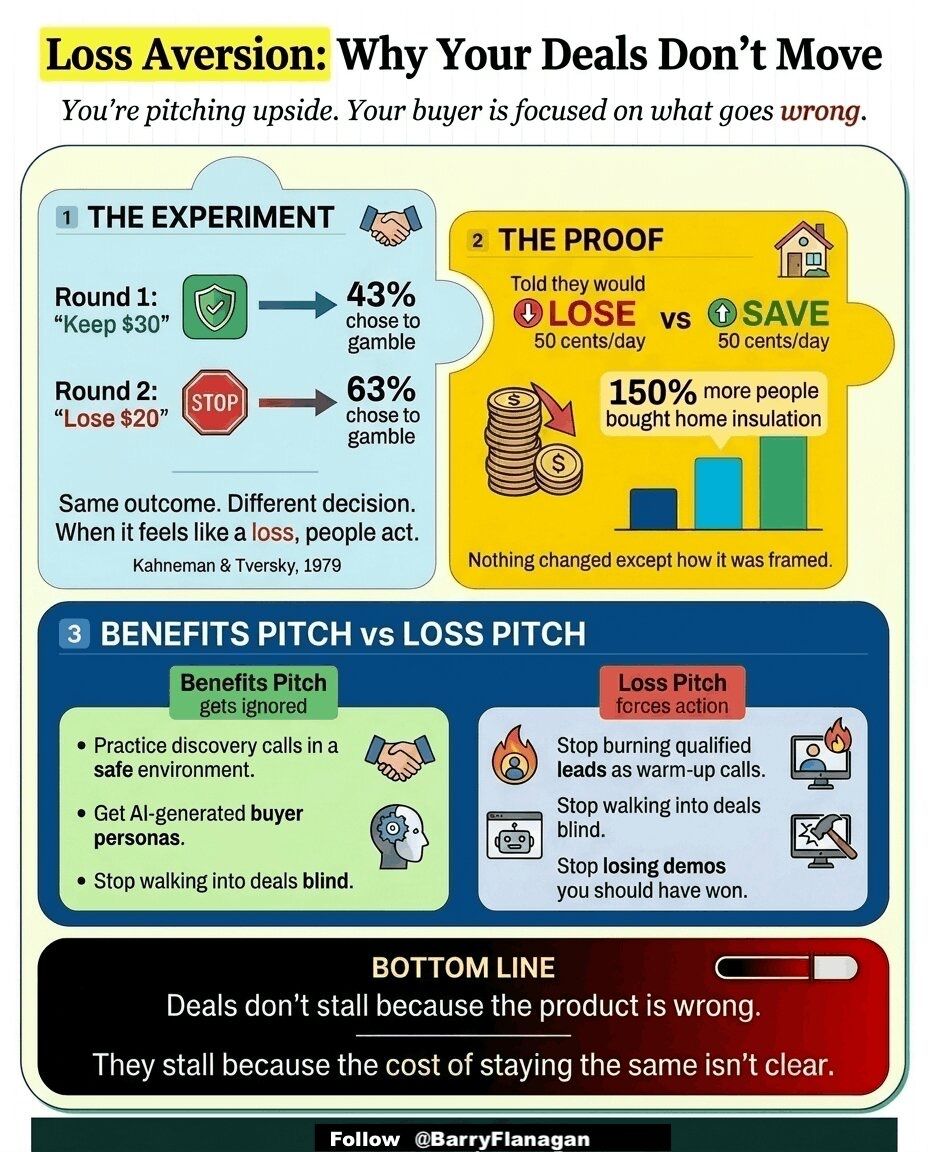
In 1979, Daniel Kahneman and Amos Tversky ran a simple test.
They gave people $50 and two choices.
Keep $30, or gamble to keep all $50. 43% gambled.
Lose $20, or gamble to keep all $50. 63% gambled.
Same numbers. Different decisions.
When people see a loss, they act to avoid it. You see this in sales constantly.
A study on home insulation tested two messages:
“Save 50 cents a day” vs “Lose 50 cents a day”
The second one drove 150% more purchases. Nothing changed except the framing.
Now look at your last pitch. “Practice discovery calls in a safe environment.”
That sounds optional. “You’re using qualified leads as practice.”
That’s a problem. “Get AI-generated buyer personas.”
Still optional. “You’re walking into deals with no idea who you’re selling to.”
Different reaction. “Prepare better for demos.”
Easy to ignore. “You’re losing deals you were already in a position to win.”
Harder to ignore. This is where deals slip.
Not because the product is wrong. Because the cost of staying the same never felt real.
So nothing changes.
And it shows up later as:
Deals that stall Pipelines that look fine but don’t convert Quarters that miss without a clear reason
Before your next email or call, read your first line again.
Is it easy to ignore. Or does it make the risk of doing nothing feel obvious.
♻️ Repost to help someone in your network 🔔 Follow Barry Flanagan for Daily Tech Sales + AI insights