Your deal is not stuck because the buyer needs more
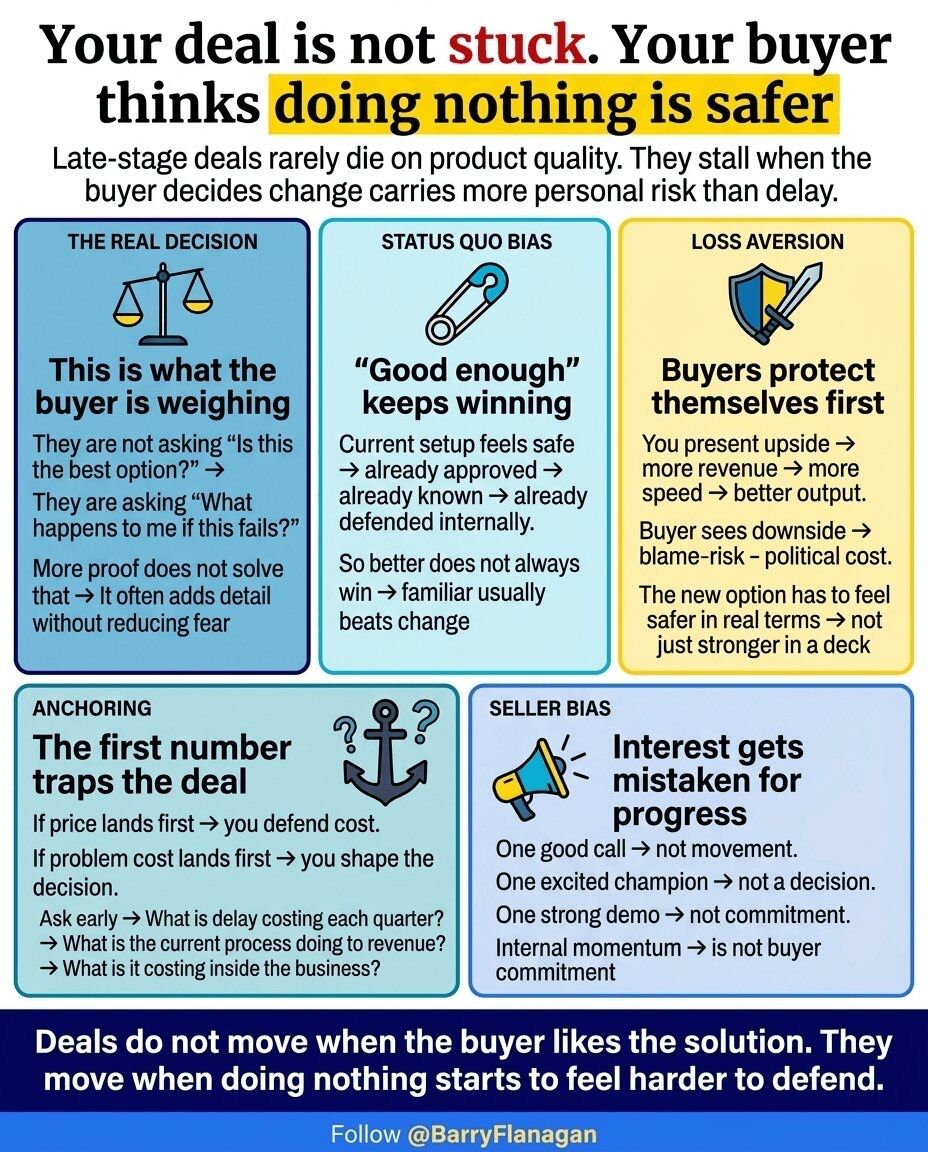
Your deal is not stuck because the buyer needs more proof. It is stuck because no decision feels safer than change.
That is where a lot of B2B tech deals stall. The seller thinks the buyer needs more confidence.
The buyer is really trying to avoid blame.
Most teams respond to that moment the wrong way. They send more follow-up.
More detail. More slides.
But the buyer is no longer asking, “Is this good?”
They are asking, “What happens to me if this goes wrong?” That is the decision.
Status quo bias wins a lot of late-stage deals. The current setup feels safe because it is already there.
Nobody gets blamed for leaving it alone. That is why “good enough” beats better.
Not because it performs. Because it protects the buyer.
If you want movement, make inaction feel expensive.
What is the delay costing each quarter? What is the current process doing to revenue? What is it doing to forecast accuracy?
What is it costing politically inside the business? Until that cost feels real, change still feels optional.
Loss aversion makes the gap even wider. The buyer feels the pain of a bad decision harder than the value of a good one.
So a benefits-led pitch often misses the real issue.
You are selling upside. They are managing downside.
The new path has to feel safer in practice, not just better on paper. Anchoring matters too.
If the first serious number is your price, you spend the rest of the deal defending cost. If the first serious number is the cost of the problem, the whole conversation changes.
And sellers bring their own bias into the deal.
One good call. One excited champion. One clean demo.
Then the forecast moves before the buyer does. Internal momentum is not buyer commitment.
Interest is not movement. A champion is not a decision.
Late-stage deals are not won by adding more information. They are won when doing nothing starts to look like the bigger risk.
♻️ Repost to help someone in your network 🔔 Follow Barry Flanagan for Daily Tech Sales + AI insights