You think your buyers
You think your buyers make decisions independently. They do not.
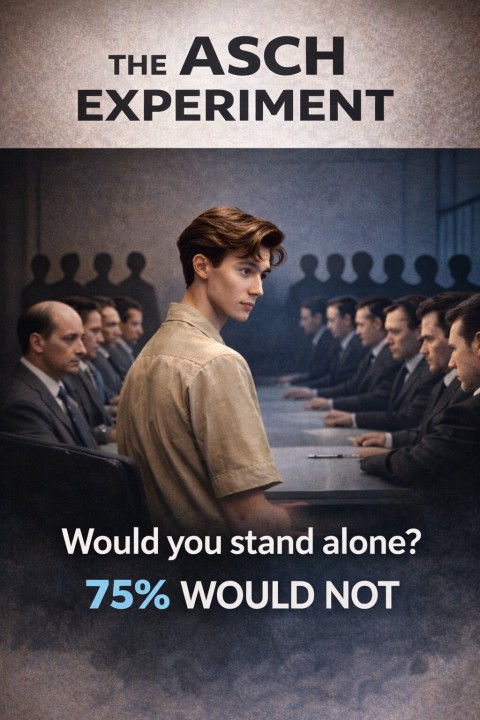
75% of people gave an answer they knew was wrong just to avoid standing alone.
Your buyers do the same when the risk feels public.
Solomon Asch ran the study in the 1950s.
People were shown a set of lines. They were asked which lines were the same size.
The answer was obvious.
Then the rest of the group gave the wrong answer. Everyone, except one person, was part of the setup.
The experiment was not really about vision. It was about what happens when your own judgment leaves you alone.
Seventy five percent followed the group at least once. Not because the group was right.
Because being the only person with a different answer feels risky. That pressure shows up in buying decisions every day.
Especially when the stakes are high and the wrong choice will be seen by other people.
This is where a lot of messaging fails.
Teams keep adding more detail. More logic. More reasons.
As if the buyer is stuck because they need one more argument.
Usually they are not.
Usually they are stuck because they do not want to be the only person who backed the wrong choice.
That is why social proof works.
A customer in the same market. A result from the same kind of company.
A story that says, someone like you chose this first, and it worked.
That does more than explain the decision. It shares the risk.
And that is the part most teams miss. Your buyer is not only deciding whether your offer is good.
They are deciding whether they want to defend it alone. Which means your buyer does not decide independently either.
🔖 Save to come back again later ♻️ Repost to help someone in your network 🔔 Follow Barry Flanagan for daily Tech Sales + AI insights